Introduction: Discovering the Charm of Solenia Light Pink
Begonia Solenia Light Pink stands out as a remarkable variety that challenges common perceptions of begonias, particularly concerning their light preferences. This plant redefines what gardeners can expect from a begonia, thriving not only in traditional partial shade but also excelling in full sun conditions. Its appeal lies in its vibrant, rose-like blooms and attractive foliage, offering exceptional versatility for a wide array of garden applications. Known for its continuous flowering and relatively undemanding nature, Begonia Solenia Light Pink provides a spectacular display of double rose-pink flowers that persist throughout the growing season. This ability to flourish in brighter environments opens up new design possibilities for gardeners seeking to introduce the lush beauty of begonias into sunnier spots.
Meet Begonia Solenia Light Pink: Botanical Insights & Key Characteristics
Begonia Solenia Light Pink is botanically known as Begonia x hiemalis ‘Solenia Light Pink’ (‘Beman Hellrosa’PBR) and is a prominent member of the Solenia Series. It is commonly classified under the Hiemalis Begonia or Rieger Begonia group. Rieger begonias themselves are hybrids, resulting from a cross between wax begonias and tuberous begonias. This genetic background is crucial, as it explains how Solenia inherits the showy, often double flowers characteristic of tuberous and Rieger types, while also gaining improved sun tolerance, a trait more associated with wax begonias. This makes Solenia a modern, enhanced begonia variety that combines desirable attributes from both parent groups.
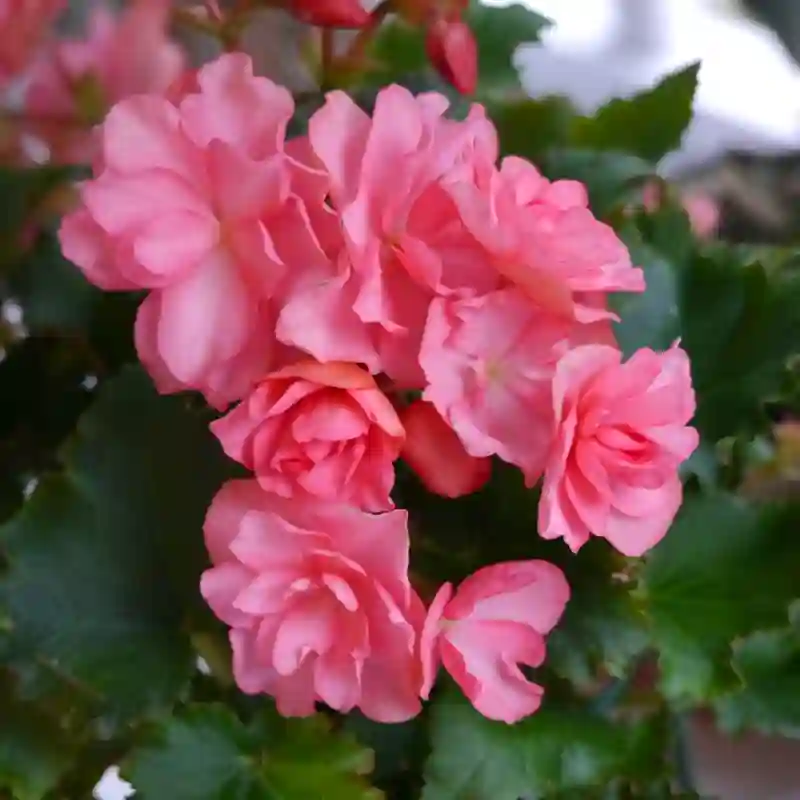
The plant produces dainty, double shell pink frilly flowers that remarkably resemble miniature roses. These prolific blooms appear in clusters, gracing the plant from mid-spring through mid-fall. Complementing the exquisite flowers is its foliage: heart-shaped, deep dark green leaves that possess a waxy, glossy texture, sometimes with serrated or frilled edges. These leaves maintain their vibrant green color throughout the year.
In terms of growth habit, Begonia Solenia Light Pink is described as a tender, rounded, bushy herbaceous perennial, typically forming a mounded shape. Its trailing and mounded habit makes it particularly outstanding for use in containers and various garden settings, including along retaining walls. The foliage tends to remain dense right to the ground, eliminating the need for facer plants in front. Mature plants generally reach a height of 8 to 15 inches (20-38 cm) and spread 8 to 12 inches (20-30 cm). It typically reaches its ultimate height within one year.
While botanically classified as an herbaceous perennial, Begonia Solenia Light Pink is not frost-hardy and is generally treated as an annual in most climates outside of USDA Hardiness Zones 9-11. For gardeners in colder regions, this means the plant will behave as a seasonal annual if left outdoors over winter, typically requiring replacement the following year. However, it can be overwintered indoors to extend its life. A minor characteristic to note is that its flower stalks can sometimes be weak, potentially requiring staking in exposed sites or excessively rich soils to maintain their upright presentation.
Begonia Solenia Light Pink at a Glance
For a quick reference, the key characteristics of Begonia Solenia Light Pink are summarized below:
| Attribute | Description |
| Botanical Name | Begonia x hiemalis ‘Solenia Light Pink’ (‘Beman Hellrosa’PBR) |
Why Solenia Light Pink Shines: Unique Advantages for Your Garden
Begonia Solenia Light Pink offers several compelling advantages that make it a superb choice for gardeners. Its most celebrated attribute is its exceptional sun tolerance, a trait that sets it apart from many traditional begonia varieties. While many begonias are relegated to shady spots, Solenia has been uniquely bred to thrive in full sun exposure, ensuring it continues to blossom vibrantly throughout the summer even in bright, sunny locations. However, it is important to note that while it performs well in full sun, gardeners should consider avoiding hot, dry locations that receive direct afternoon sun or reflected sunlight, such as against a south-facing white wall, as this can cause stress or leaf scorch. For optimal bloom production, aiming for at least six hours of direct sunlight is beneficial.
Another significant advantage is its continuous blooming habit combined with its relatively low-maintenance appeal. This plant consistently produces flowers from mid-spring to mid-fall, providing a season-long display of color. A particularly appealing characteristic for busy gardeners is that no deadheading is necessary for these continuous blooms. This means the plant will keep flowering profusely without the need for manual removal of spent blossoms. While often described as “low maintenance” due to this feature and its general resilience, it is more accurately characterized as requiring minimal tending in some aspects but consistent care in others. For instance, achieving its full potential, especially when grown in containers, necessitates regular watering and feeding. This nuanced understanding helps gardeners manage expectations and ensures they provide the specific care needed for a truly spectacular display.
Furthermore, Solenia Light Pink exhibits commendable disease and pest resistance. It is tolerant of most common begonia diseases and resilient to typical garden pests. Its mildew resistance is a notable benefit, reducing the risk of common issues like powdery mildew and other fungal infections. The plant also boasts resistance to rabbits and is unaffected by allelopathic biochemicals released by black walnut trees. This inherent resilience is partly attributed to begonia leaves being rich in oxalic acid, a natural insect repellent. This combination of sun tolerance, continuous bloom, and robust resistance makes Solenia Light Pink a highly rewarding choice for diverse garden settings.
Cultivating Success: A Comprehensive Care Guide for Solenia Light Pink
Successful cultivation of Begonia Solenia Light Pink hinges on understanding its specific environmental preferences.
Light Requirements
As previously highlighted, Solenia Light Pink thrives in full sun to partial shade. To maximize its prolific blooming, providing at least six hours of direct sunlight is recommended. However, in regions with intense summer heat or in locations where sunlight reflects strongly (e.g., against a white wall), it is advisable to protect the plant from harsh afternoon sun. This strategic placement prevents potential leaf scorch and ensures the plant remains vigorous and healthy throughout the season.
Watering Wisdom
This begonia variety prefers consistent moisture but is highly susceptible to root issues in waterlogged conditions. It requires evenly moist, well-drained soil for optimal growth, and will quickly decline in standing water. Once established, it tolerates somewhat drier conditions, so allowing the top inch of soil to dry out between waterings is a good practice. Watering in the morning is generally preferred, and care should be taken to keep the soil moist without making it soggy, while also avoiding wetting the foliage, which can contribute to fungal diseases. Plants grown in outdoor containers and hanging baskets will typically require more frequent watering than those planted directly in the ground, as their soil dries out faster. The emphasis on “well-drained” soil is a critical preventative measure against common begonia ailments like stem rot and rhizome rot. Gardeners in humid climates or those prone to overwatering should be particularly diligent about ensuring excellent drainage to prevent these issues.
Soil & Nutrients
Solenia Light Pink performs best in rich, well-draining soil. An ideal soil pH range is between 6.0 and 6.5, which is slightly acidic to neutral. If planting in containers, always choose pots with drainage holes. For in-ground planting, amending the soil with perlite or compost can significantly improve drainage and enrich the growing medium.
Consistent feeding is vital for supporting its continuous blooming habit. During the active growing season, fertilize the plant every two weeks using a balanced plant food, such as a 10-10-10 or 20-20-20 formula. If flowering begins to diminish, switching to a phosphorus-rich fertilizer, like a 10-30-10 blend, can help stimulate more blooms. This strategic approach to fertilization is a key factor in maximizing the plant’s aesthetic appeal and ensuring a season-long display of flowers.
Temperature & Overwintering
As a tender plant, Begonia Solenia Light Pink is not frost-hardy. In most climates outside of USDA Zones 9-11, it is cultivated as an annual. However, gardeners wishing to preserve their plants can overwinter them indoors. One method involves drying off the tubers in winter and storing them in a frost-free environment. Alternatively, the entire plant can be brought indoors before the first frost. To do this, cut back its growth, place the plant in a sunny window, and keep the soil slightly moist throughout the winter. While the plant may not bloom indoors during this period, it should survive until spring, ready to be moved back outdoors once all risk of frost has passed.
Pruning & Maintenance
Solenia Light Pink is notably low maintenance, primarily because it does not require deadheading to continue blooming. While it generally looks its best without extensive pruning, it will tolerate light trimming if needed. The main pruning task involves removing old stems and foliage as the plant naturally dies back for winter. As mentioned, some plants may require staking if their flower stalks become weak, particularly in exposed locations or overly rich soils. Applying a thick layer of mulch around the root zone during the growing season can also help conserve soil moisture, reducing the frequency of watering.
Expanding Your Collection: Propagating Solenia Light Pink
Begonias, including the Solenia series, are generally straightforward to propagate, offering gardeners the opportunity to expand their collection or share plants with others.
Stem Cuttings
Propagating from stem cuttings is a popular and effective method. Begin by identifying a healthy, thick stem on a rhizomatous begonia, ensuring it has no bruises or damage that could lead to rot. Cut the stem into 2-inch sections, with each section containing at least one bud or growing point. The cut should be made just below the bottom node, as this is where rooting is most efficient. Place these stem cuttings on a shallow bed of perlite or sphagnum moss, gently pushing them down to ensure full contact with the medium. Alternatively, stem cuttings can also be rooted in water. Once placed, cover the cuttings with clear plastic to maintain high humidity, which is crucial for root development. Keep the setup in a warm, bright location, ideally above 70°F (21°C), but out of direct sunlight. Mist the soil as needed to keep the cuttings consistently moist. New plants typically begin to form roots and leaves in about six to eight weeks, at which point they can be carefully transplanted into their own containers once they have three to four new leaves.
Leaf Cuttings
Leaf cuttings are another viable method. Select a healthy leaf from the parent plant. Using a sterile razor blade, make cuts through the underside veins of the leaf, approximately a quarter of the way from the petiole (leaf stem). New plants will emerge from these cuts, so it is important to avoid damaging the surrounding leaf tissue. Place the leaf top-side up on the surface of a sterile growing mix, such as seed sowing mix, perlite, or sphagnum moss. To ensure good contact between the leaf and the medium, place a few small pebbles on the leaf near the cut veins. Cover the pot with plastic wrap to create a humid environment. Position the leaf in a bright location with indirect sunlight and maintain temperatures above 70°F (21°C) for optimal growth. While this process can take some time, new plants will typically begin to form in about three to four weeks, eventually developing leaves, rhizomes, and roots. Once these plantlets are well-formed, they can be carefully divided and transplanted into individual pots.
Division and Seed Propagation
Begonia Solenia Light Pink can also be propagated by division in the spring. For propagation from seed, select a healthy, dry seed pod or purchase a seed packet. Moisten a sterile seed-starting mix thoroughly and add it to small seed-starting cells or trays. Gently shake the tiny seeds evenly across the moistened mix, but do not cover them. Lightly spritz the surface with water to help secure the seeds in place, then cover the containers with clear plastic wrap or a plastic shell to maintain humidity. Keep the covered containers in a bright, warm location, away from direct sunlight. The use of a horticultural warming pad and LED grow lights can accelerate seedling growth.
It is important for gardeners to be aware that as a cultivated variety, Begonia Solenia Light Pink may be subject to certain restrictions or prohibitions on propagation. For home gardeners propagating a few plants for personal enjoyment or sharing, this is generally not an issue. However, for larger-scale or commercial propagation, it is advisable to consider any potential Plant Breeders’ Rights or patent restrictions.
Common Challenges: Pests & Diseases to Watch For
While Begonia Solenia Light Pink is celebrated for its resilience, particularly its tolerance to most common begonia diseases and garden pests , and its mildew resistance , it is not entirely immune to problems. Understanding potential issues allows for proactive management.
The plant may occasionally be susceptible to certain pests, including caterpillars, mealybugs, thrips, glasshouse red spider mite, vine weevil, and aphids. Its natural oxalic acid content in leaves does offer a degree of insect repellence , but vigilance is still advised.
Regarding diseases, while generally tolerant, Solenia Light Pink can be susceptible to grey moulds, powdery mildews, stem rot, and rhizome rot. The presence of these diseases often points back to environmental conditions that can be managed through proper cultivation. For instance, stem rot and rhizome rot are frequently linked to overwatering or poorly draining soil. Therefore, the best defense against these specific diseases is strict adherence to appropriate watering practices—avoiding wet foliage and ensuring the soil is well-drained and never soggy. Good air circulation around the plant also plays a crucial role in preventing fungal issues like powdery mildew and grey moulds. By prioritizing these preventative care measures, gardeners can significantly minimize the risk of most common pests and diseases, allowing Solenia Light Pink to thrive with minimal intervention.
Designing with Solenia Light Pink: Versatile Planting Ideas
Begonia Solenia Light Pink’s mounded and trailing growth habit, combined with its continuous, vibrant blooms, makes it an exceptionally versatile plant for various garden designs. It is an ideal choice for:
- Hanging Baskets and Containers: Its cascading and mounded form makes it perfect for hanging baskets, patio pots, and deck planters, where its profusion of flowers can spill over the edges.
- Mass Planting and Borders: It excels when mass-planted in flower borders or used as edging, creating a continuous, vivid display of color and texture. Its dense foliage naturally fills out to the ground, eliminating the need for additional facer plants.
- City and Courtyard Gardens: Its adaptability to various light conditions and compact size make it well-suited for urban gardening spaces.
- Conservatories and Greenhouses: It can also be grown permanently under glass, providing year-round beauty.
Solenia Light Pink is often recommended as a “filler” in the popular ‘spiller-thriller-filler’ container combination. In this role, its mounded form and abundant flowers create a lush, colorful base, allowing taller “thriller” plants to stand out vertically and trailing “spiller” plants to cascade gracefully over the container’s edge. This specific application highlights its ability to add intrigue and flare to any container or landscape. Its vibrant display also makes it an excellent alternative to plants like red geraniums, especially given its no-deadheading feature.
Solenia Light Pink in Comparison: How It Stacks Up Against Other Begonias
The world of begonias is vast and diverse, encompassing fibrous (wax), tuberous, rhizomatous, and cane types. Begonia Solenia Light Pink, as a Rieger Begonia, is itself a hybrid of fibrous and tuberous begonias, specifically bred for enhanced characteristics. Understanding how Solenia compares to other popular begonia varieties helps gardeners make informed choices for their specific needs.
Solenia vs. Rieger Begonias (General)
Solenia is a specific series within the broader Rieger Begonia group. Traditional Rieger begonias typically prefer little to no direct light and cooler temperatures, often thriving as indoor houseplants. The critical distinction for Solenia is its unique breeding for greater sun tolerance, allowing it to flourish in conditions that would stress or damage other Rieger varieties. This makes Solenia a more versatile outdoor option.
Solenia vs. Wax Begonias (Begonia semperflorens)
Wax begonias are classic, prolific bloomers known for their compact, mounded habit and tolerance of hot, sunny conditions, making them a popular choice for garden beds and containers. While Solenia shares some sun tolerance with wax begonias, its hybrid nature (partially derived from wax begonias) means it offers larger, more rose-like flowers than the smaller blooms typical of wax begonias. Solenia also offers the benefit of continuous blooming without the need for deadheading, a feature that can be a deciding factor for many gardeners.
Solenia vs. Tuberous Begonias (e.g., Nonstop®, Illumination® series)
Tuberous begonias, such as the Nonstop® and Illumination® series, are prized for their large, vibrant double blooms. However, they are primarily shade-loving plants, preferring part shade or full shade conditions, and tend to suffer (“get crispy”) in full sun. They thrive in warm temperatures. Solenia’s key differentiator is its ability to perform exceptionally well in full sun, making it a “top performer for sun,” whereas Non-Stop begonias are best suited for providing color in shade beds. A helpful mnemonic to remember this distinction is to think of the French word for sun, “soleil,” which sounds like “Solenia”. Additionally, Solenia’s leaves are typically rounder and a deeper, glossier green compared to those of Non-Stop varieties.
Solenia vs. Dragon Wing Begonias
Dragon Wing begonias are highly adaptable, thriving in sun and part-sun conditions, and are also notably drought tolerant. They are characterized by a spreading, arching habit, making them an excellent choice for hanging baskets and container arrangements, and feature distinctive wing-like foliage. In contrast, Solenia Light Pink maintains a more mounded habit. While both tolerate sun, Solenia is specifically bred for robust performance in full sun, making it a strong contender for the sunniest spots.
Solenia vs. Surefire Begonias
Surefire begonias are quite similar to Dragon Wing varieties in their adaptability and vigor but possess a more upright growth form. Like Solenia, they are well-suited for sun to shade conditions. The primary difference lies in their growth habit: Solenia maintains a mounded form , while Surefire varieties are distinctly upright.
Solenia Begonia Comparisons
The following table provides a concise comparison of Solenia Light Pink with other popular begonia types:
| Begonia Type | Light Preference | Growth Habit | Key Features/Uses | Differentiator from Solenia |
| Begonia Solenia Light Pink | Full Sun to Partial Shade | Mounded/Trailing | Rose-like double blooms, waxy leaves, continuous bloom, no deadheading, disease/pest resistant, filler | Reference point |
| Rieger Begonias (General) | Partial Shade to Shade | Upright/Bushy | Double blooms, bright colors, shorter bloom time, often houseplants | Less sun-tolerant, prefer cooler temperatures |
| Wax Begonias | Sun to Part-Sun | Compact Mounded | Prolific small blooms, green or bronze foliage, low cost, bedding plant | Smaller, less showy flowers |
| Tuberous Begonias (e.g., Non-Stop, Illumination) | Part Shade to Shade | Mounding/Trailing | Large, vibrant double blooms, jewel tones, love warm temps | Require shade, prone to scorching in sun |
| Dragon Wing Begonias | Sun to Part-Sun (adaptable) | Spreading/Arching | Wing-like bright green foliage, prolific pink/red blooms, drought tolerant, excellent for hanging baskets | More spreading/arching habit, Solenia bred for more intense sun |
| Surefire Begonias | Sun to Shade | Upright | Similar to Dragon Wing but more upright, vigorous | More upright habit |
Companion Plants: Perfect Partners for Your Solenia Light Pink
Selecting appropriate companion plants is key to creating harmonious and visually impactful garden displays with Begonia Solenia Light Pink. The ideal companions should share similar light requirements (sun to part-shade) and watering needs (moist but well-drained soil). Given Solenia’s role as a “filler” in container compositions, companions that offer contrasting textures, heights, and foliage colors can significantly enhance the overall aesthetic.
For striking foliage contrast, consider:
- Coleus (Coleus scutellarioides): Available in a vast array of vibrant leaf colors and patterns, Coleus (such as ColorBlaze® Mini Me™ Watermelon or ColorBlaze® Chocolate Drop) provides excellent textural and color contrast, especially in shaded areas.
- Hostas: Their large, lush leaves offer a bold, contrasting backdrop for the delicate blooms of begonias.
- Sweet Potato Vine (Ipomoea): Known for its vigorous, trailing, and spreading habits, Sweet Potato Vine comes in various colors and can cascade beautifully over container edges, creating a dynamic interplay with Solenia’s mounded form.
- Persian Shield: Its iridescent purple foliage can provide a dramatic contrast against Solenia’s green leaves and pink flowers.
- Hakonechloa macra grass: Yellow varieties of this ornamental grass can add a fine texture and bright color accent.
- Dusty Miller: With its soft, silvery-gray foliage, Dusty Miller offers a textured contrast, particularly effective in moderate to full sun.
For flowering companions that complement Solenia’s continuous bloom, consider:
- Impatiens (including New Guinea Impatiens): While traditional impatiens thrive in partial to full shade, New Guinea Impatiens can tolerate moderate sun and offer vibrant blooms, making them suitable companions in mixed light conditions.
- Astilbes: Their feathery plumes add vertical interest and a different texture, complementing the rounded blooms of begonias.
- Browallia: An easy-to-care-for, shade-tolerant annual with vibrant blue or white star-shaped flowers.
- Fuchsia: Often grown in hanging baskets, Fuchsia produces tubular, teardrop-shaped flowers that are a favorite of hummingbirds and thrive in low to partial sun.
- Torenia: Also known as Wishbone Flower, Torenia offers delicate blooms and thrives in shaded areas.
- Lobelia: This popular moderate sun annual produces tiny but bold flowers in shades of blue, violet, and white, making it a great option for hanging baskets or containers, though it prefers to avoid hot, direct sun.
Specific combinations that have proven successful include planting Solenia with sweet potato vine and Duranta Gold Edge for a mix of textures and colors. Another appealing combination involves pairing Solenia with purple Persian shield and yellow Hakonechloa macra grass. For a vibrant container, Solenia can be combined with Caladium varieties like Heart to Heart® ‘Lemon Blush’ Shade Caladium and Heart to Heart® ‘Raspberry Moon’ Shade Caladium, creating a rich tapestry of color and form.
Conclusion: Embrace the Radiance of Solenia Light Pink
Begonia Solenia Light Pink represents a significant advancement in begonia cultivation, offering gardeners a plant that delivers stunning, rose-like blooms with remarkable sun tolerance. Its continuous flowering from mid-spring to mid-fall, coupled with its low-maintenance nature—especially its freedom from deadheading—makes it an exceptionally rewarding choice for both novice and experienced gardeners. The plant’s versatility allows for its use in a myriad of garden applications, from vibrant hanging baskets and patio containers to mass plantings and border edgings.
While it is botanically a perennial, its tender nature means it is best treated as an annual in colder climates, though overwintering options exist for those wishing to preserve their plants. Its inherent disease and pest resistance further contribute to its ease of care, provided basic cultivation principles regarding watering and drainage are followed. By understanding its unique characteristics and providing appropriate care, gardeners can transform their outdoor spaces with the radiant and lasting color of Begonia Solenia Light Pink, truly embracing the beauty and resilience of this exceptional begonia.

If i die, water my plants!